TEST: Biwin UD150 128GB USB flash drive
Here you can find a detailed performance and benchmark test of the USB flash drive UD150 with 128GB (UD150-128GB) from Biwin.0
0,10 $
| Technical data | |
| Image | 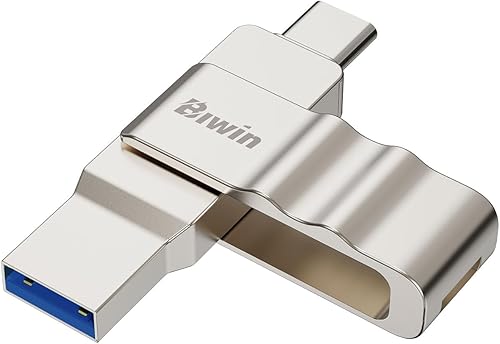
|
| Manufacturer | Biwin |
| Model number | UD150-128GB |
| Storage capacity | 128 GB (118 GiB) |
| Read speed | 150 MB/s |
| Write speed | 50 MB/s |
| Interface | USB 3.2 Gen 1x1 (5 Gbit/s) |
| Connection | USB Typ A+C |
| Price | ca. 13 USD (= 0,10 $ / GB) |
| Paid link | Buy on Amazon |
Compared to the top performer*
*) Test result evaluated according to AS SSD Score within the same size.
AS SSD Benchmark
Standard performance test
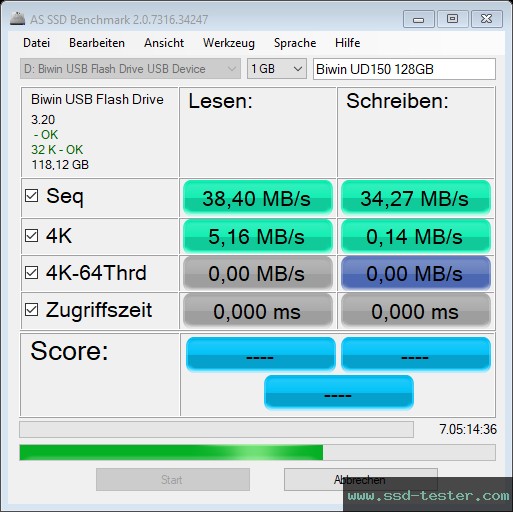
The standard test was performed using a 1 GB file. A total score of 0 points was achieved.
| AS SSD | Read: | Write: |
|---|---|---|
| Seq in megabytes per second |
38,40 MB/s |
34,27 MB/s |
| 4K in megabytes per second |
5,16 MB/s |
0,14 MB/s |
| 4K-64Thrd in megabytes per second |
0,00 MB/s |
0,00 MB/s |
| Access time in milliseconds |
0,000 ms |
0,000 ms |
| Score | 0 |
0 |
| Total score | 0 |
|
Copy Performance Test
A common everyday situation is simulated here. Three test folders are created:
- ISO (folder with two large files)
- Program (folder with many small files)
- Game (folder with small and large files)
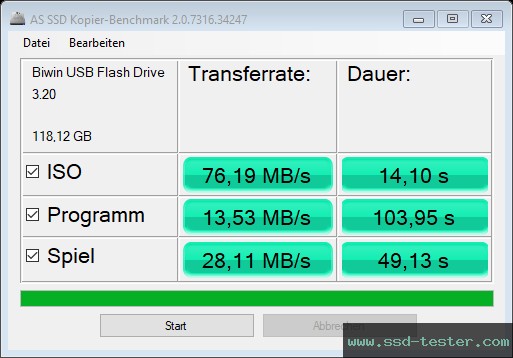
The three folders are copied using the Windows Copy command (the cache remains enabled). The practical test of September 08, 2025 shows the performance for simultaneous write and read operations. The lower the duration, the better the performance.
| AS SSD Copy-Benchmark | Transfer rate: | Duration: |
|---|---|---|
| ISO two large files |
76,19 MB/s |
14,10 s |
| Program many small files |
13,53 MB/s |
103,95 s |
| Game small and large files |
28,11 MB/s |
49,13 s |
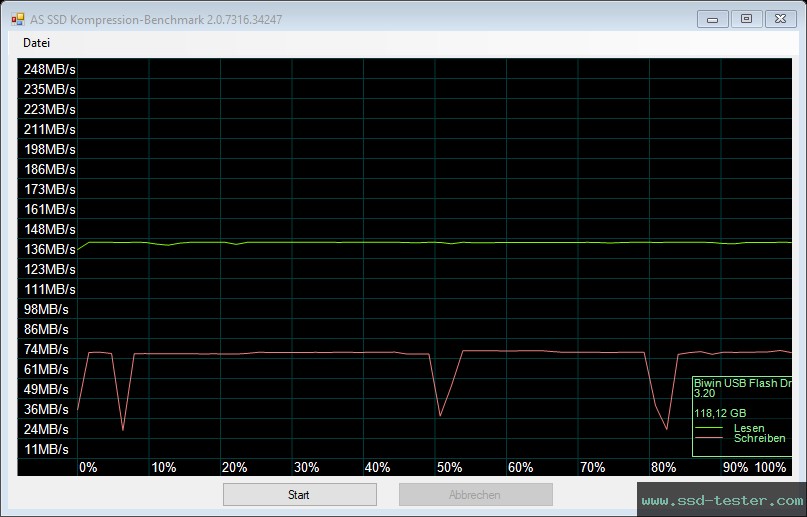
Compression Performance Test
This measures the write and read speed of the Biwin USB flash drive, depending on the compressibility of the data (according to the manufacturer, these should be 150 MB/s and 50 MB/s respectively ).
CrystalDiskMark Benchmark
Here, two sequential and two random performance tests are performed, similar to the ones performed on the AS SSD.
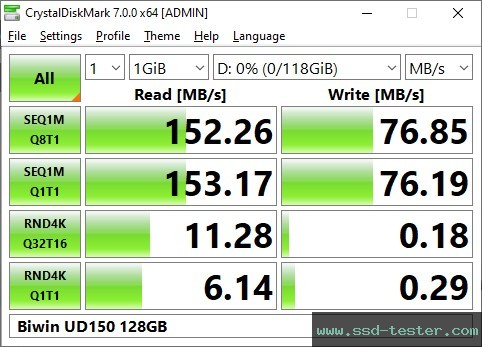
| CDM | Read [MB/s] | Write [MB/s] |
|---|---|---|
| SEQ1M Q8T1 |
152,26 |
76,85 |
| SEQ1M Q1T1 |
153,17 |
76,19 |
| RND4K Q32T16 |
11,28 |
0,18 |
| RND4K Q1T1 |
6,14 |
0,29 |
Input/Output operations per second
| CDM | Read [IOPS] | Write [IOPS] |
|---|---|---|
| SEQ1M Q8T1 |
145,20 |
73,30 |
| SEQ1M Q1T1 |
146,10 |
72,70 |
| RND4K Q32T16 |
2.753,70 |
43,70 |
| RND4K Q1T1 |
1.499,80 |
71,00 |
Average latency
| CDM | Read [µs] | Write [µs] |
|---|---|---|
| SEQ1M Q8T1 |
54.688,60 |
107.779,00 |
| SEQ1M Q1T1 |
6.842,06 |
13.735,30 |
| RND4K Q32T16 |
110.330,00 |
2.033.110,00 |
| RND4K Q1T1 |
666,30 |
14.027,50 |
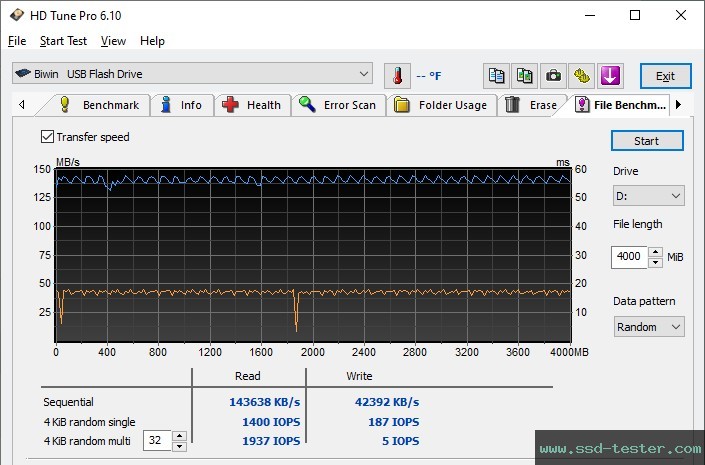
HD Tune Pro Endurance test
This is a long term test to make full use of the memory capacity. You can see when a cache is full and the writing performance decreases. A test file of 4 GB was written to the medium.
ATTO Disk Benchmark
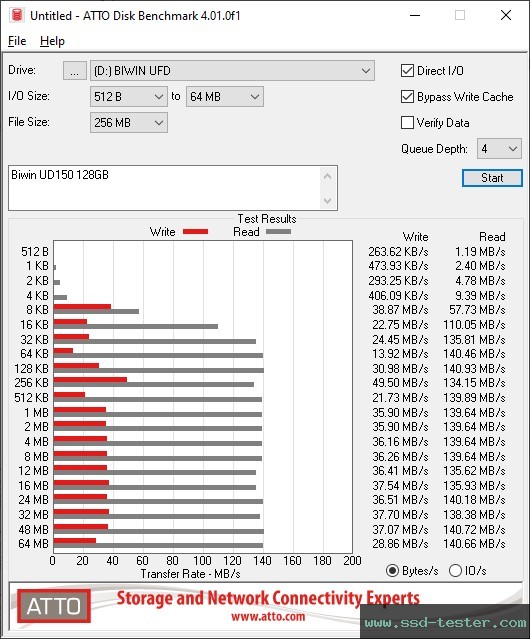
Here, a 256 MB file is written several times to the 128 GB Biwin USB flash drive. The I/O block size varies (from 512 bytes to 64 megabytes). The larger the blocks, the faster they were written and read.
SSD-Z Benchmark
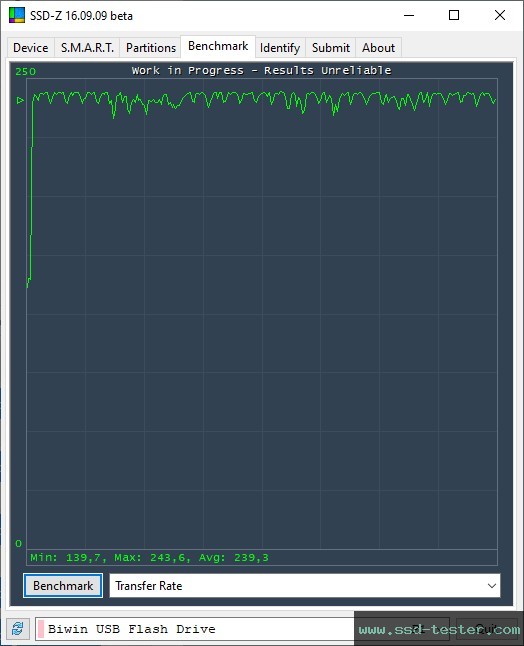
Similar to HD Tune, a 500 MB file is written to the 128 GB Biwin USB flash drive here. The transfer data is displayed. The more constant the line, the better.
Information about the test system can be found at the bottom of the home page.
As an Amazon Associate I earn from qualifying purchases.